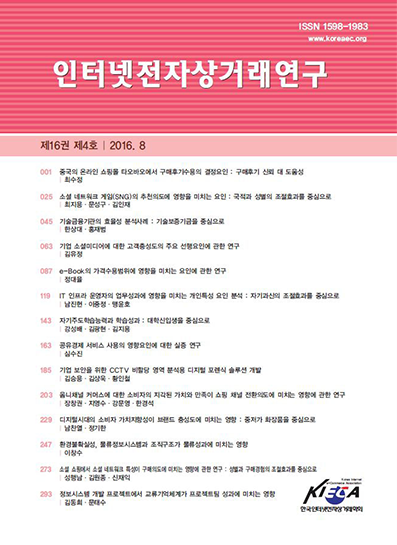
사단법인 한국인터넷전자상거래학회는 전자상거래 연구의 특성상 무엇보다도 학제적 접근이 요구된다는 점에서 전자상거래와 관련된 경영학, 경영정보학, 경제학, 무역학, 법합, 관광학 등 사회과학뿐만 아니라 전산학 등 공학을 전공한 분들이 전자상거래의 발전에 필요한 제반 이론을 연구하고 발전시키는 학술단체입니다. 이러한 학회의 설립 목적에 부합하기 위해 학회에서는 연6회(국문 : 2월, 6월, 8월,12월, 영문 : 4월, 10월) "인터넷전자상거래연구"를 발행하고 있습니다.
연구재단 등재지(KCI)인 "인터넷전자상거래연구"는 연구 논문의 게재를 통해 회원들에게 학문 토론을 위한 기회의 장을 제공하며 사회적 이슈 및 최신 동향 등 다양한 분야를 포함하고 있습니다.
"인터넷전자상거래연구"에 투고된 논문은 다음과 같은 심사 기준에 의해 3인 이상의 엄정하고 공정한 심사를 거쳐 질 높은 논문을 게재하고 있습니다.
연구재단 등재지(KCI)인 "인터넷전자상거래연구"는 연구 논문의 게재를 통해 회원들에게 학문 토론을 위한 기회의 장을 제공하며 사회적 이슈 및 최신 동향 등 다양한 분야를 포함하고 있습니다.
"인터넷전자상거래연구"에 투고된 논문은 다음과 같은 심사 기준에 의해 3인 이상의 엄정하고 공정한 심사를 거쳐 질 높은 논문을 게재하고 있습니다.
최근 발간 목록 (25권 6호, 12월 2025)
생존분석기법을 적용한 Yelp 리뷰 기반 레스토랑 재방문 행동 실증연구
류세영 이병현 김수일 김재경
This study applies survival analysis techniques to examine customer revisitation behavior in the restaurant industry, with a focus on identifying key determinants and comparing the predictive performance of traditional and deep learning-based models. Utilizing a large-scale dataset of Yelp reviews collected from across the United States, we estimate survival curves using the Kaplan?Meier method and evaluate group differences through log-rank tests. To account for the joint effects of multiple factors, we employ the Cox Proportional Hazards Model and validate its proportionality assumption. Results show that price range, cuisine type, operating hours, noise level, and alcohol availability significantly influence customer revisitation likelihood. Specifically, low-priced restaurants and those offering quiet environments or limited alcohol options exhibited higher revisitation rates. The Cox model revealed that price range was the most influential factor, with a clear gradient of increased revisitation hazard for lower-priced restaurants. To address potential non-linearities and improve prediction, we implemented DeepSurv, a deep learning-based survival model. DeepSurv achieved a 3.2% higher C-index compared to the Cox model, along with a reduced loss function, demonstrating improved predictive accuracy. This research contributes methodologically by introducing survival analysis to restaurant revisit studies and empirically by identifying actionable variables that influence return behavior. This study holds practical significance by providing strategic insights for restaurant managers to enhance customer revisitation through the adjustment of pricing strategies, operating hours, and other service environments.
텍스트 마이닝을 통한 LLM 확산 전후 ‘AI 건축’ 연구 동향 분석
이권형 김상희 류지혜 김백준 이종화
This study examines how the thematic structure and conceptual focus of “AI architecture” research in Korea have evolved before and after the diffusion of large language models (LLMs).
Abstracts of papers published in the DBpia database between 2019 and 2025 were analyzed using text-mining techniques, including word frequency, TF IDF, network centrality, and CONCOR analysis. The results show that pre-LLM studies mainly addressed design, space, energy, and construction performance, emphasizing technological functionality and optimization. After LLM diffusion, keywords such as generative, image, intelligence, model, and BIM emerged, reflecting a transition toward data-driven, automated, and creative design processes. Network and clustering analyses further revealed that AI architecture research shifted from performance-oriented technical applications to open, multidisciplinary structures centered on AI-based creation and intelligent modeling. These findings demonstrate that the diffusion of LLMs marked a paradigm shift in AI architecture from tool-based application to conceptual reconstruction of the design act providing a foundation for future research on AI human collaborative and generative design.
부정적 온라인 리뷰가 구매의도에 미치는 영향과 기업 및 AI 챗봇 응답의 조절효과: 럭셔리 브랜드를 중심으로
윤스텔라 신하진 김수림 양희동
This study empirically examines how negative online reviews affect consumers’ purchase intentions for luxury brands and compares the moderating effects of corporate versus chatbot responses. Negative reviews were classified into price, quality, and service related types, and a scenario based online survey using luxury brand was conducted. PLS-SEM analysis revealed that negative reviews significantly decreased purchase intention across all three categories. However, only service related reviews showed a statistically significant moderating effect of response type.
Price and quality, perceived as intrinsic values of luxury brands, remained unaffected by rebuttals, while service related reviews were influenced by official corporate or chatbot responses, which alleviated negative perceptions and partially restored purchase intention. These findings suggest that consumers perceive service as an interactive, alterable element, unlike price or quality. The study provides theoretical insights into online review communication as practical implications for reputation management strategies in luxury brand digital marketing.
A Case Study on the Determinants of Fighter Aircraft Acquisition in Eastern Europe: An Extended Analysis of IT-Based Interoperability
여인준 김진수
This study examines the determinants of fighter aircraft acquisition in Eastern Europe, with a particular focus on IT-based interoperability. Russia’s military expansion and the war in Ukraine have accelerated modernization and pushed states to replace aging Soviet-made platforms with NATO-standard aircraft. By analyzing six cases Poland, Romania, Slovakia, Bulgaria, Croatia, and Serbia the research identifies five categories shaping procurement: security environment, alliance and diplomacy, fiscal and procurement conditions, operational-technical factors, and IT-based interoperability.
The findings show that acquisition decisions are shaped not only by performance or cost but by the interplay of urgent security needs, alliance commitments, budgetary constraints, delivery schedules, and NATO system compatibility. Poland’s combined purchase of F-35s and FA-50s demonstrates how advanced capability and rapid delivery can be balanced, while Romania, Bulgaria, and Croatia illustrate different strategies for managing fiscal limits and operational gaps. Serbia’s Rafale purchase highlights the use of acquisition as a diplomatic signal.
The study expands defense procurement research by highlighting IT-based interoperability such as tactical data link integration as a critical determinant, and offers implications for South Korea’s defense exports. The FA-50’s strengths in timely delivery, cost-effectiveness, and NATO interoperability are identified as key competitive advantages in the European market.
농어촌 공유숙박 리뷰에 관한 다층적 분석: 공간, 시간, 감성의 관점에서
김부성 안민영 김태영 유동희
Rural and coastal regions in South Korea face growing sustainability challenges from population decline, aging, and vacant housing. Airbnb’s detached accommodations have become a key means of revitalizing local economies and regenerating cultural landscapes by turning idle housing into tourism assets. Understanding the detailed needs and emotions of visitors is essential for sustaining rural tourism vitality and maximizing these regional benefits. Despite Airbnb’s rising importance especially after COVID-19 increased demand for contact-free lodging most prior studies have focused on metropolitan areas, offering limited insights into rural contexts. This study applies text mining to Airbnb reviews from rural (Sancheong, Hamyang, Hadong) and coastal (Namhae) regions of Gyeongnam Province from February 2020 to May 2025. The analysis reveals that during the pandemic, rural visitors emphasized spatial satisfaction and SNS sharing, while coastal visitors valued scenic experiences. After the pandemic, priorities shifted toward host satisfaction, cleanliness, and visual appeal, with hygiene issues remaining the core negative concern.
Academically, this study expands the literature on sharing accommodation by bridging spatial, emotional, and temporal perspectives, offering a multidimensional understanding of rural and coastal Airbnb experiences. It further demonstrates how sentiment-based text analytics can serve as an empirical tool for linking tourism behavior with regional sustainability.
AI 개인화 서비스에서 대학생의 개인정보 보호 규제 인식이 만족도에 미치는 영향: 지각된 유용성의 매개와 프라이버시 민감성의 조절효과
이청림 최은지
As AI-powered personalization rapidly expands, users increasingly face a trade-off between convenience and privacy anxiety. In this context, understanding whether privacy regulations function as a signal of institutional trust has become a timely and essential question. This study investigates the effects of perceived privacy regulation on users’ perceived usefulness and personalization satisfaction, while examining the mediating role of perceived usefulness and the moderating role of privacy sensitivity. A survey was conducted among 312 university students in Gyeonggi Province who had experience using AI programs such as ChatGPT and Sora. Data were analyzed using SPSS 29.0 and PROCESS Macro. The results revealed that perceived privacy regulation had a significant positive effect on both perceived usefulness (β = .552, p < .01) and personalization satisfaction (β = .568, p < .01). Moreover, perceived usefulness partially mediated the relationship between privacy regulation and satisfaction, while privacy sensitivity moderated the relationship—indicating that users with higher sensitivity were more responsive to regulatory cues. These findings highlight that privacy regulation is not merely a legal safeguard but a cognitive trust mechanism that enhances users’ acceptance and satisfaction with AI services. The study extends the Privacy Calculus Theory by integrating institutional trust and individual differences, proposing an AI trust governance model that bridges regulatory assurance and user psychology.
모바일 뱅킹의 가치와 부담 인식: 사용자 경험의 통합적 관점
안재영 신대솔 윤혜정
As the five major commercial banks reduced their physical branches and shifted toward mobile-based, contactless services, the digital transformation of the financial sector accelerated.
Consequently, mobile banking has evolved from a mere transactional channel into a core customer interface platform, heightening the importance of users’ experiences and perceptions for continued service usage. In response to this transformation, this study investigates how positive and negative factors perceived in mobile banking services influence users’ perceived value and continuance intention. User review data were collected from both major domestic commercial and internet-only banks, and key determinants were identified through topic modeling analysis. Based on the Value-Based Adoption Model, hypotheses were developed and empirically tested. The findings indicate that usefulness, ubiquity, and complexity have significant effects on perceived value, whereas continuous improvement and responsiveness show no significant influence. Furthermore, perceived value positively affects users’ continuance intention toward mobile banking. These results empirically clarify the mechanism through which users’ value perceptions drive continuance behavior in an increasingly mobile-centered financial service environment, offering practical implications for developing digital channel strategies and enhancing customer experience oriented services in commercial banking.
학습자-학습내용 상호작용이 지각된 학습성과에 미치는 영향:창의적 문제해결 능력의 매개효과와 LMS 유용성 조절 효과
정윤정 이희옥
This study examined the effect of learner content interaction on perceived learning outcomes, focusing on the mediating role of creative problem-solving ability and the moderating role of learning management system(LMS) usefulness. The research model was grounded in the Interactive Constructive Active Passive(ICAP) framework and the Information System Success Model (DeLone & McLean, 2003). Survey data were collected from 248 university students enrolled in LMS-based courses at universities in Busan, South Korea. Using SPSS 29.0 and the PROCESS macro(Preacher & Hayes, 2008), hierarchical regression and bootstrapping analyses were conducted.
The results revealed that learner content interaction significantly and positively predicted creative problem-solving ability and perceived learning outcomes. Creative problem-solving ability partially mediated the relationship between learner content interaction and perceived learning outcomes.
Furthermore, LMS usefulness attenuated the effect of learner content interaction on creative problem-solving ability. These findings suggest that learner content interaction facilitates cognitive transfer to perceived outcomes through creative problem solving, yet high LMS usefulness may reduce exploratory learning by fostering procedural dependency. Therefore, instructional design should incorporate inquiry-oriented tasks, meaningful feedback, and performance-based assessments.
In addition, LMS functions should be optimized to encourage autonomous thinking rather than procedural dependency.
중소기업이 인지한 정부지원이 혁신성과에 미치는 영향 : 기업 융합역량의 지연효과를 중심으로
김신영 부귀현 조부연
SMEs account for the majority of domestic firms and serve as key economic actors in Korea. In a rapidly changing technological environment, securing diverse forms of intellectual property has become essential for their survival and growth. However, due to limitations in resources and capabilities, SMEs face inherent challenges in independently generating innovation outcomes, making government support policies critical across the entire cycle of innovation activities. Although the scale of government support for SMEs has continued to expand and policy efforts have been strengthened, existing studies have primarily focused on fragmentary causal links between government support and performance, with relatively few examining long-term relationships among support, firm capabilities, and innovation performances.
This study collected three years of data (2022-2024) from SMEs that received government support programs and analyzed the impact of firms’ perceived government support on innovation performance, focusing on the structural pathways mediated by convergence capabilities. The empirical findings indicate that the enhancement of firm capabilities and the realization of innovation performances through government support occur gradually over time, highlighting the importance of adopting a long-term perspective that reflects temporal effects. Furthermore, the results suggests the need for more tailored, capability-oriented support policies that reflect firms’ needs, objectives, and internal capabilities.
머신러닝을 활용한 화물차 교통사고 심각도 예측 및 위험 요인 규명: 경상남도를 중심으로
정민수 이승연 이상근
This study aims to predict the severity of freight truck traffic accidents in Gyeongsangnam-do, a major industrial and logistics hub, and to identify the structural factors that escalate accidents into high-risk outcomes (severe injury or fatality). To overcome the limitations of previous studies, such as data leakage and overfitting caused by using small sample sizes or post-accident variables, this study analyzed a total of 174,521 traffic accidents occurred from 2007 to 2024. We strictly excluded post-accident variables to prevent data leakage and used only pre-accident environmental variables.
The SMOTE technique was applied to resolve class imbalance, and an XGBoost-based classification model was developed to predict high-risk accidents. Additionally, spatial analysis using QGIS was conducted to verify the regional distribution of risk factors.
The results showed that freight truck accidents had a significantly higher rate of severe outcomes (56.7%) compared to passenger cars, proving their structural danger. Feature importance analysis identified 'freight truck operation' itself, along with 'collision with pedestrians/two-wheelers', 'major traffic violations (speeding)', and 'nighttime driving' as key triggers determining accident severity.
Spatial analysis revealed high-risk accident hotspots concentrated in logistics routes connecting major industrial complexes in Changwon and Gimhae. This study contributes academically by presenting a realistic risk prediction model that addresses data limitations. Based on the findings, we suggest practical policy measures such as physical segregation of trucks and pedestrians and the implementation of total energy (speed) control systems.